
// Technology log
Riding the Storm Tide: Haible’s Bounce Flanger

STATUS: BUILT
CATEGORY: EFFECTS
YEAR: 2008
THE MISSION: A FLANGER
Riding the Storm Tide: Haible's Bounce Flanger
Back in 2008 I was deep into the Electro Music forum, watching for anything new coming out of the DIY synth underground, when Jurgen Haible himself posted about a new project: the "Son of Storm Tide" flanger, the successor to his earlier one-off "Storm Tide Flanger."
I jumped on it almost immediately, exchanged a few messages with Jurgen over the forum, and shortly after had a board in hand. It became one of the earliest Haible projects I ever built, long before I knew it would turn into a lifelong habit.

1.1 //FROM STORM TIDE TO SON OF STORM TIDE

Jurgen's original "Storm Tide Flanger" was a one-off box he built for himself, heavily inspired by the Eventide Instant Flanger, a device that had already gone far beyond what most people think a flanger should do. The SOST wasn't a reissue of that circuit. It used different BBD chips, departed from the vintage layout, and folded in a handful of features Jurgen had developed himself, alongside a few borrowed and reinterpreted from other classic effects units.

By the time he announced it on Electro Music Forum, the design had matured into something that could be built as a Frac-Rack style module, a 19" unit, or even - as Jurgen himself suggested - stripped down to a stompbox with just a Manual knob and the Bounce function.
1.2 //THE SOUND YOU'VE ALREADY HEARD

Before getting into what makes the SOST tick, it's worth pointing at where its ancestor - the Eventide Instant Flanger - actually shows up on record, because most people have heard it without knowing it.

Tony Visconti used the Instant Flanger to create the haunting, seasick piano intro on David Bowie's "Ashes to Ashes" a sound that's become almost as identifiable as the song itself.

Cyndi Lauper's "Time After Time" leans on the same box, applied in stereo to the shaker, giving it that wide, breathing motion sitting behind the vocal.

Eventide themselves point to Led Zeppelin's Physical Graffiti and Jefferson Airplane as further carriers of that unmistakable Instant Flanger character, alongside "countless others" who reached for the same rack unit once it hit studios in 1975.

None of this is the SOST circuit itself, of course - Jurgen built his own thing rather than cloning Eventide's box. But the DNA is direct: the Bounce feature, the multi-source modulation, even the general philosophy of "flanging as an instrument rather than an effect" all trace straight back to that machine. Every time I hit the Bounce control on my SOST, I hear a little bit of "Ashes to Ashes" in there.


1.3 //NOT YOUR STANDARD FLANGER

Calling the SOST "just a flanger" undersells it. Jurgen carried over several ideas from the Eventide Instant Flanger and the ARP Quadra Phaser that most flanger circuits never touch:

A resonance limiter borrowed from the ARP Quadra Phaser's compander system, which keeps the resonance peak locked to a fixed level above the input signal rather than letting it "scream" once it clips.

A Foldback stage that folds negative control voltage back up instead of just clipping it, keeping the BBD clock from collapsing to unusably low rates.

And then there's Bounce - probably the most distinctive feature of the whole circuit. A fast, single sweep of the Manual or Pedal control triggers a sub-audio bandpass filter feeding a nonlinear amplifier with positive feedback, which sends the clock frequency into a series of decaying "echoes" in both directions, faster and slower. It's Jurgen's electronic emulation of the way a reel-to-reel tape machine's speed bounces when the friction against the reel suddenly releases. Nothing about it sounds like a conventional pedal flanger.

For the full breakdown of these features - Theta Processing, Thru-Zero Flanging, the compander design, and more - Jurgen's own SOST project page is the definitive source; I won't try to out-write him on his own circuit.
1.4 //LIFE IN THE MODULAR RIG

The first board went straight into my modular system, where it stayed for years and ended up on a few of my early albums. It had that unmistakable "not quite a flanger, not quite a phaser" character running through raw modular waveforms, and once I had it patched in I found myself reaching for it constantly.

Eventually, though, I had to let the module go. Life happens, systems get reshuffled, and the SOST was one of the casualties.

1.5 //A SECOND LIFE IN 19" 2U

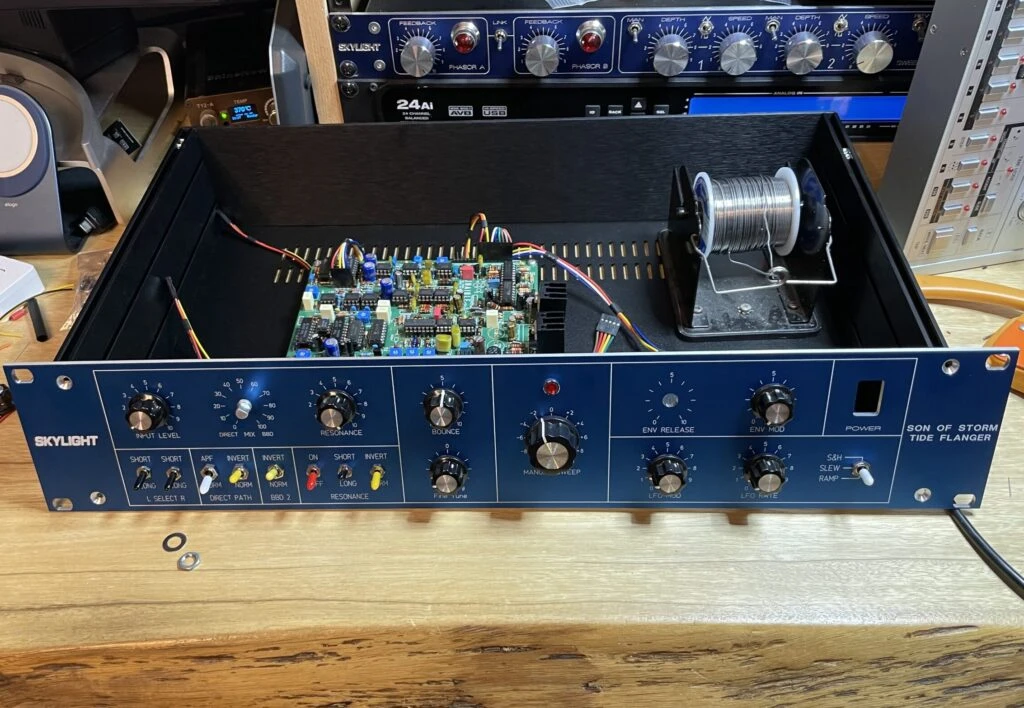
A few years ago I decided to bring it back, this time in a 19" 2U rack format, using the modern board recreation offered through Serge Modular's continuation of Jurgen's legacy designs.

The circuit itself hadn't changed, but the format finally matched how the rest of my outboard gear lives in the studio.

It should have been a straightforward rebuild. It wasn't.
1.6 //THE BOARD THAT REFUSED TO MODULATE

The freshly built board powered up, passed audio, and did absolutely nothing else. No modulation, no sweep, nothing. I went through the usual DIY ritual - rechecking every resistor, every trimmer, every solder joint - and came up empty every time. Eventually I put the boards and the half-finished case aside, unable to find the fault, and left the project alone for a while.

When I came back to it with fresh eyes, I found the culprit: the board had been supplied with an SMD LM3046 transistor array instead of the through-hole part the layout called for. On an otherwise fully populated board, that meant desoldering a tiny SMD package wedged in among dozens of other components without damaging anything around it - not a fun afternoon. Once I got it out and replaced it with a new SMD unit, the circuit came alive on the first power-up. It was a reminder that with these boards, when nothing else makes sense, it's worth questioning the parts that came in the kit before questioning your own soldering.

1.7 //A FRONT PANEL OF MY OWN

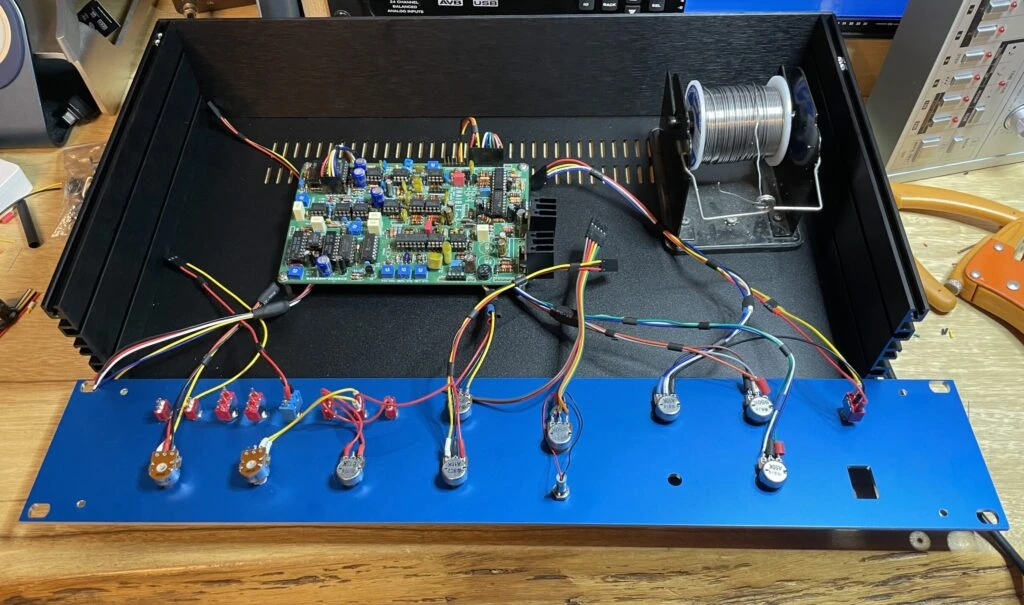
Rather than replicate Jurgen's original front panel layout exactly, I designed a new one - close enough in spirit to stay recognizable as a SOST, but laid out and labeled to fit how I actually use it and how the rest of my rack looks. It's a small thing, but it's the difference between a faithful clone and a unit that feels like it belongs on my bench.
2.0 //REFLECTIONS

This one has a longer history than most things on my bench - from a Electro Music thread in 2008, straight from Jurgen himself, to a dead board shelved in frustration, to a 19" rack unit with my own panel on the front of it. Between the resonance limiter, the Foldback, and especially Bounce, it still doesn't behave like anything else in the rack, which is exactly why it earned its spot back after all these years.

It's also one more small thread tying back to Jurgen Haible directly - a designer whose generosity with the DIY community, mine included, shaped a good part of how I build to this day.
