
// Technology log
Crafting the Legendary Solina Wall of Sound
STATUS: BUILT
CATEGORY: EFFECTS
YEAR: 2008
THE MISSION: LUSH STRINGS
Crafting the Legendary Solina Wall of Sound
After my successful Schulte phaser build, and riding on my increased confidence in building Haible designs, I looked for what else does Haible have for my growing DIY appetite. Phaser I already had so I looked for something else that could enrich my "ordinary" modular sounds.
Enter the late Jurgen Haible's legendary Solina/String Ensemble Emulator, better known as the JH Triple Chorus. Fresh off the triumph of finishing my Krautrock Phaser, this became the second crucial effect unit in my Frac Rack modular setup, setting the stage for turning thin, static saw waveforms into massive acoustic landscapes.

1.1 // THE LEGACY OF EMINENT, ARP AND THE '70 STRING MACHINES

To understand why this specific circuit is a masterwork of vintage emulation, we have to look back to the early 1970s. The Dutch manufacturer Eminent changed the music world when they introduced the Eminent 310 Unique electronic organ, featuring a radical new "Orbitone" triple-BBD ensemble effect.

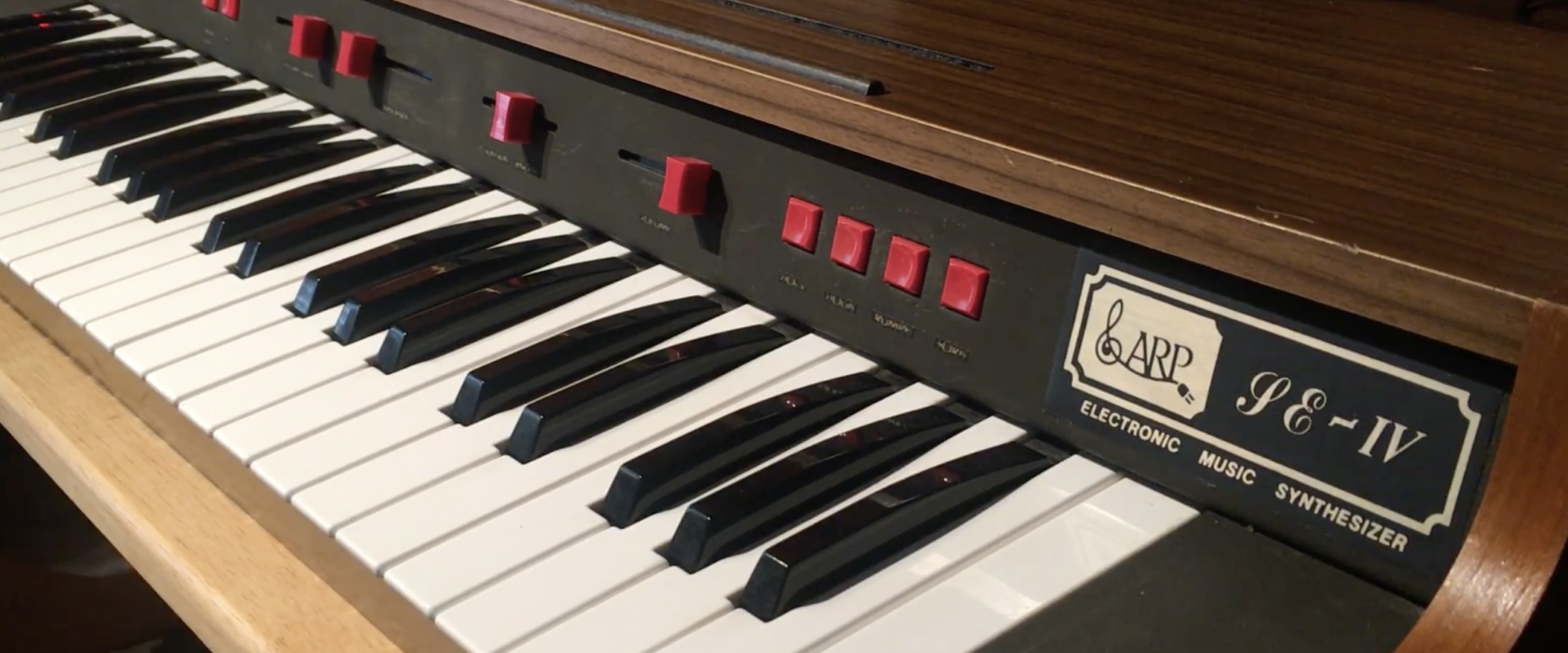
The sound was so spectacularly lush that they extracted that specific chorus circuit, packaged it into a standalone keyboard, and licensed it to ARP. Thus, the ARP Solina String Ensemble was born. It became the defining polyphonic texture of 1970s pop, disco, and progressive rock, offering a hauntingly beautiful, silky alternative to a real symphonic string section.
1.2 // THE SOUND OF THE PIONEERS

The Solina sound was the sonic backbone for an entire generation of keyboard pioneers who needed to flesh out their tracks with an otherworldly orchestral presence:

Jean-Michel Jarre: His groundbreaking albums Oxygene and Equinoxe are virtually defined by the Eminent 310 Unique organ and the Solina strings, providing those sweeping, liquid string pads that floated over his sequencer lines.

Tangerine Dream: During their classic mid-70s "Virgin Years," the band leaned heavily on the Solina String Ensemble. Tracks across Phaedra, Rubycon, and Ricochet rely on the Solina to provide a deep, melancholic orchestral floor beneath their pulsing step-sequencer patterns.

Pink Floyd: Richard Wright heavily favored the ARP Solina on iconic tracks like "Shine On You Crazy Diamond", using its massive, rich warmth to fill out the spaces beneath David Gilmour's guitar solos.

The Cure: Robert Smith and his keyboardists used the Solina's distinctive, melancholy string texture to anchor the gloomy, gothic atmospheres of their definitive post-punk records.
1.3 // ARCHITECTURE OF THE 3-PHASE CIRCLE

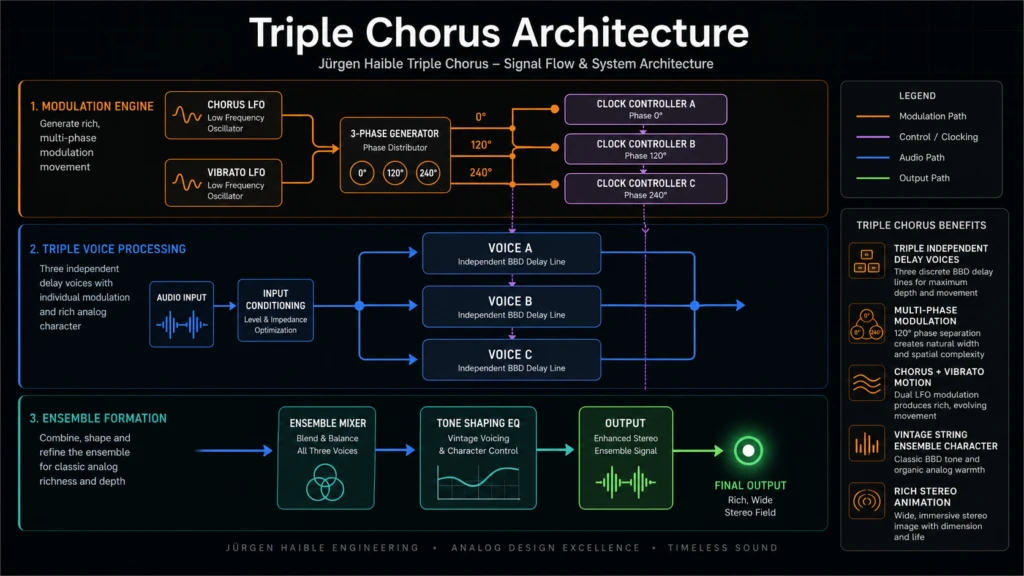
The secret to the Solina magic lies in a brilliant piece of psychoacoustic engineering.

On their own, string machines generated thin, phase-locked, robotic sawtooth waves using cheap top-octave divider chips. The Triple Chorus transforms this via three parallel Bucket Brigade Delay (BBD) channels.

To break the static electronic nature of the input, the three delay lines are modulated by Low-Frequency Oscillators (LFOs) offset by exactly 120∘ apart (0∘, 120∘, and 240∘). This creates a perfectly balanced "moving circle" of sound. As the delays shift out of phase, they induce a micro-tonal Doppler pitch-shifting effect, masking the original electronic source and tricking the human ear into hearing an ensemble of multiple string players moving together in a physical room.
1.4 // CHORUS MEETS VIBRATO

Jurgen Haible's emulator meticulously duplicates the exact LFO mathematics of the original Eminent design, avoiding complex digital microcontrollers in favor of pure analog genius. To keep the modulation from sounding repetitive or predictable, the circuit generates two entirely separate 3-phase modulation signals at once:

"Chorus": A slow, deep, majestic sweep ticking away at roughly 0.6 Hz.
"Vibrato": A fast, shallow, frantic wobble running at roughly 6 Hz.

The circuit vectors these two speeds together across all three BBD clock drivers (Line 1 gets Chorus 0∘ + Vibrato 0∘, Line 2 gets the 120∘ mix, and Line 3 gets the 240∘ mix). The resulting compound modulation is a beautifully chaotic, non-repeating shimmer that perfectly mimics the natural variance of human string players.


1.5 // TRANSFORMING THE SIMPLE SAW

Building the Triple Chorus right after the Schulte Phaser was a revelation. Having learned my lesson from my previous "misplaced resistor" mishap, I approached the Haible chorus board with extra precision. When I finally powered the unit up in its Frac Rack housing and patched a dead-simple, single analog sawtooth wave from my new DIY modular synth into the input, the result was staggering.

The flat, harsh wave instantly dissolved, replaced by a massive, weeping, majestic string texture. It was an astonishing validation of Jurgen's layout design, it didn't just sound like a chorus pedal; it completely altered the DNA of the raw synthesizer waveforms.

In order to get string polyphony, I connected my Oberheim Matrix 6R standard saw wave and I could finally play lush chords with no effort.
1.6 // SOURCING AND TECHNICAL QUIRKS

For purists looking to replicate this build today, Jurgen's original circuit board layouts can still be purchased via legacy DIY channels and official archives like Random*Source or synthCube.

However, committing to the original board means staying strictly faithful to its vintage component architecture, which brings a specific set of challenges:

The TDA1022 BBD: The classic Solina sound relies on a very specific stage-to-clock ratio. Jurgen's original design is hard-wired for three ITT TDA1022 (512-stage) BBD chips. Because 512 stages offer a relatively short internal delay, the master clocks must run at an incredibly high frequency (40kHz to 120kHz). This pushes the inherent BBD clock hiss completely out of the audible spectrum, resulting in a sparkling, silky high-end. Because these chips are New Old Stock (NOS) and long out of production, you must source them carefully from reputable synth-DIY forums or verified electronic surplus dealers to avoid re-marked counterfeits.

The Negative Voltage Power: In a world dominated by standard bipolar ±12V or ±15V modular rails, the classic Haible board stands out because it runs entirely on a single −15V power rail (drawing roughly 62mA). If you are integrating this into a modern modular system, your power routing and distribution require careful planning to avoid frying the circuit.

True Stereo Spatialization: The module features a highly unique output arrangement, providing independent outputs for the individual channels alongside a main mix. To unlock the full power of the module, you must pan these channels hard left and right on your mixer, throwing the stereo image so wide it sounds like it's wrapping around the back of your head.


2.0 // REFLECTIONS

Standing next to my Krautrock Phaser, the Frac Rack Triple Chorus remains one of the proudest achievements of my early synth-building days. It proved to me that the true magic of analog synthesis doesn't just come from the oscillators, but from the idiosyncratic, brilliant engineering of the effects processing behind them.

If you have already tackled a phaser and want to truly elevate your DIY modular rig into a cosmic, symphonic time machine, tracking down those TDA1022 chips and building a Haible Triple Chorus is the ultimate next step.