
// Technology log
Yamaha CS-80: Engineering the Blade Runner Sound
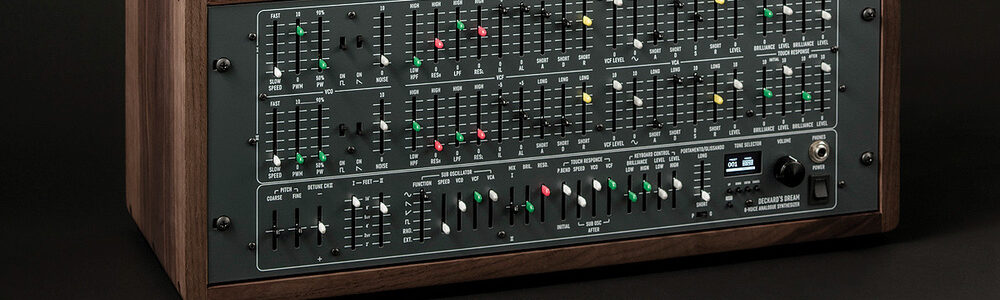
STATUS: COMPLETED (DREAM IS REAL)
CATEGORY: POLY-SYNTHS
YEAR: 2018
THE MISSION: CS-80 RECREATION
Yamaha CS-80:Engineering the Blade Runner Sound
When Hans Zimmer stepped into the world of Blade Runner 2049, he didn't reach for a plugin; he reached for the Yamaha CS-80. Respecting Vangelis' original 1982 score meant returning to the most expressive analog synthesizer ever built.
I knew I needed that sound, but I didn't have the space, or the budget, for a vintage 110kg titan.

1.1 // BLACK CORPORATION: THE REBELLION BEGINS


In 2017, a whisper went through the synth community: Black Corporation was attempting the impossible. Their project, Deckard's Dream, promised an 8-voice rack-mounted unit that could replicate the exact soul of the Blade Runner soundtrack.

The waiting list was legendary, but after a year of anticipation, I finally got "in."
1.2 // THE INVENTORY: NO ROOM FOR ERROR

This was my first poly-synth project, and the stakes felt massive. To avoid the nightmare of sourcing thousands of individual components, I opted for a full parts kit from synthcube.com.
When the DIY kit arrived with all the PCB boards, I realized the scale of the task, there was no pre-programmed firmware here. Bringing this unit to life required an ST-Link and a very steady hand.


1.3 // THE CENTRAL NERVOUS SYSTEM: TWO CONTROL BOARDS

The architecture of the Dream is split into two halves. The first board is the tactile surface, housing the sliders and switches that allow you to "play" the electronics. The second board is the brain, hosting the CPU, voice cards slots, noise circuitry, and the power supply.

A word of warning for future builders: the power supply and voice card connectors look identical. I had to physically block off pins to ensure I didn't fry the most sensitive parts of the machine.
1.4 // THE ASSEMBLY LINE: EIGHT HEARTS BEATING AS ONE

Building 8 identical voice cards, each with its own VCO, filter, and envelope, is a test of endurance. To minimize errors, I treated my workbench like a professional assembly line: I gathered parts for all 8 boards at once and soldered them in a single, focused rhythm.

Over the last 8 years, I've had to perform minor surgery on these cards, usually replacing V2164 VCA ICs, but the modular nature of the build makes it a "forever" instrument.


2.0 // THE DREAM REALIZED: VANGELIS AT YOUR FINGERTIPS

The result is breathtaking. I have the legendary sounds of the late '70s and early '80s at my fingertips, but without the 110kg footprint. Thanks to MIDI MPE support, I can achieve the same "breath" and expressiveness as the original CS-80.

This machine has become the backbone of my studio, haunting almost every track on my albums Delta and Memoria Technica.
2.1 // BONUS: THE EXPANDER

The original CS-80 was defined by its unique ring modulator. Since the main Deckard's Dream unit lacks onboard effects, I also built the Expander to bridge the gap. However, my journey with the Expander ended early; while it "hijacks" MIDI to create authentic ring modulation, the other digital effects felt less vital to my workflow.

I kept the "Dream," but I let the Expander go.
